Before You Live It, Write It: How Your Journal Becomes a Permission Slip for Who You're Becoming

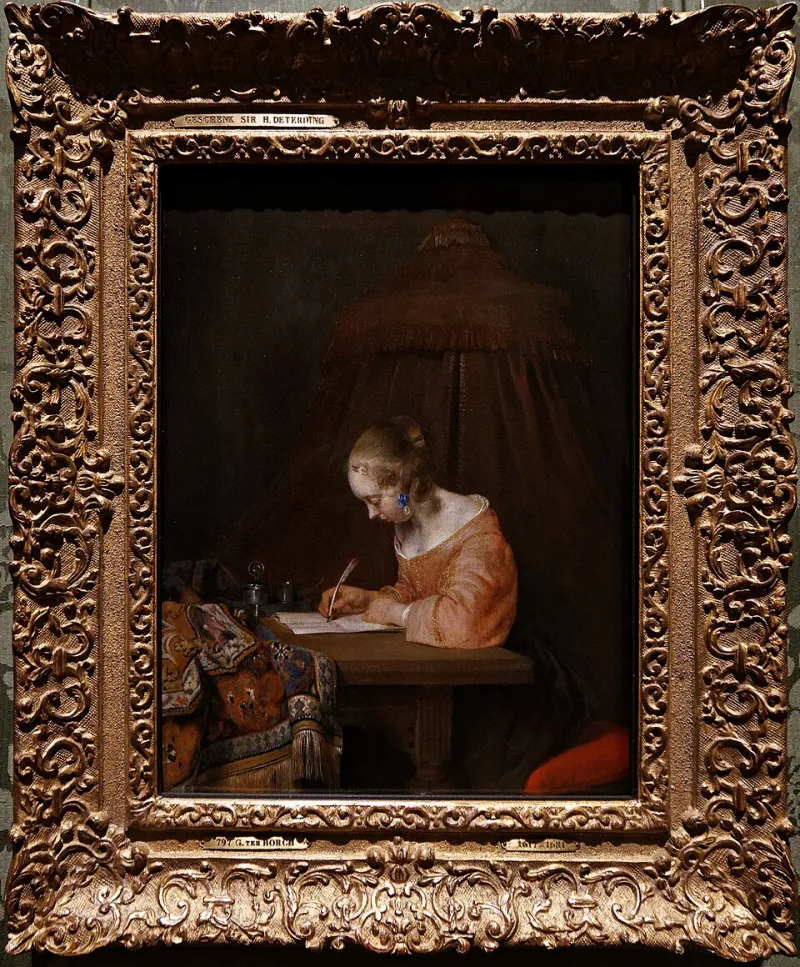
Photo: Gerard ter Borch, Public domain, via Wikimedia Commons
Somewhere between your current self and the version of you that you keep imagining, there's a page. Maybe it's dog-eared, maybe it's got coffee rings on the corner, maybe you wrote in it at 11 p.m. when the house finally got quiet. But on that page, you said something true — something you hadn't said out loud yet, maybe hadn't even fully admitted to yourself.
You wrote it down anyway.
And something shifted.
That's not magic. Or — okay, maybe it's a little bit magic. But it's also deeply psychological, and once you understand what's actually happening when you journal about a life you haven't lived yet, you'll probably never look at a blank page the same way again.
The Strange Power of Naming Something Before It Exists
Here's something worth sitting with: the moment you write I want to leave this job and start something of my own or I think I'm ready to stop shrinking myself in relationships, you've done something irreversible. You've made the thought visible. And visible things are harder to ignore.
Psychologists call this identity-based intention setting — the idea that when we frame our desires as part of who we are (not just what we want to do), we're more likely to act on them. Journaling is one of the most natural ways to do this, because the act of writing forces you to slow down and actually choose your words. You can't scribble "I am becoming someone who prioritizes her creativity" and walk away unchanged. Some part of your brain just filed that under "true things about me."
That's the permission slip at work.
Why Documentation Creates Internal Authority
We live in a culture that loves external validation. We wait for someone else to tell us we're ready — a boss, a partner, a certification, a sign from the universe. But journaling quietly dismantles that waiting game, because when you write something down in your own hand, in your own words, you become the authority on it.
There's no committee. No approval process. Just you, the page, and the sentence you just committed to.
This matters more than it sounds. A lot of us have been taught — implicitly, through years of schooling and social conditioning — that we need permission to want things. Permission to change. Permission to take up space in a new way. The journal bypasses all of that. It creates a private record that says: I saw this in myself. I named it. I gave it room.
That's not journaling as diary-keeping. That's journaling as self-authorization.
The Gap Between the Writing and the Doing Is Not Wasted Time
Here's where people sometimes get frustrated: you write about a version of yourself, and then... you don't immediately become that person. You close the journal, go back to your regular Tuesday, and wonder if any of it meant anything.
It did. It just works on a slower clock than we expect.
Think of that gap — the space between writing something and actually living it — as a kind of internal composting. You've introduced new material. Your subconscious is now processing it, cross-referencing it with your existing beliefs, testing it against your fears, quietly rearranging things. This is why people often report that after journaling seriously about a change they wanted to make, opportunities or clarity seemed to show up "out of nowhere." They weren't out of nowhere. The groundwork had already been laid on the page.
The writing primes you to notice what was always there. It tunes your attention.
Writing the Identity Before the Evidence Shows Up
One of the most uncomfortable — and ultimately liberating — things you can do in a journal is write about yourself as if something is already true when you don't yet have the proof.
Not in a toxic positivity, manifest-it-into-existence way. More like... trying on the clothes before you buy them.
I'm someone who makes time for creative work. (Even if right now, you haven't in months.)
I handle conflict with more patience than I used to. (Even if you're still working on it.)
I trust my instincts. (Even if they've led you wrong before.)
Writing these things doesn't make you a liar. It makes you a person who is practicing. And practice, by definition, happens before mastery. The journal is where you rehearse the version of yourself you're building toward — and rehearsal, in any creative discipline, is taken seriously. Actors rehearse. Musicians rehearse. Athletes rehearse. Why wouldn't you?
What Happens When You Go Back and Read It
One of the most underrated parts of keeping a journal over time is the moment you flip back through old entries and find something you wrote six months ago — some longing, some intention, some half-formed hope — and realize you're now living it.
That moment is genuinely disorienting in the best way. Because you can see the throughline. You can trace the path from the page to the present. And that evidence — your own evidence, in your own handwriting — becomes one of the most convincing things you'll ever encounter about your own capacity to change.
It also makes you more willing to write the next big thing. Because now you know: the page holds it until you're ready.
A Few Ways to Start Using Your Journal as a Permission Slip
If this resonates but you're not sure where to begin, here are some low-pressure entry points:
- Write a letter from your future self. Let her tell you what the transition felt like. What she's glad you did. What she wants you to stop worrying about.
- Name the identity out loud. Instead of "I want to be more creative," try "I am a creative person who is still figuring out her medium." Feel the difference.
- Document the desire without the plan. You don't need to know how. Just write what you want with as much specificity and honesty as you can. The how tends to show up after the what gets clear.
- Revisit and respond. Come back to old entries. Have a conversation with your past self. Argue with her if you need to. Notice where she was right.
The Page Knows Before You Do
There's a reason so many people describe their journals as the one place they feel completely honest. Not because it's easy to be honest there — it's often the opposite. But because the page doesn't flinch. It doesn't tell you your dreams are too big or your timeline is off or that you should be more realistic.
It just holds what you give it.
And sometimes, what you give it is the first true glimpse of who you're actually becoming — before you've done a single thing to prove it. That glimpse is real. That glimpse counts. And writing it down might be the most important first step you take.
So go ahead. Write the thing you're not ready to say out loud yet. Give it a page. Give it your handwriting.
That's the permission slip. You just signed it.