The Art You Make Without Thinking: What Lives in the Margins of Your Journal
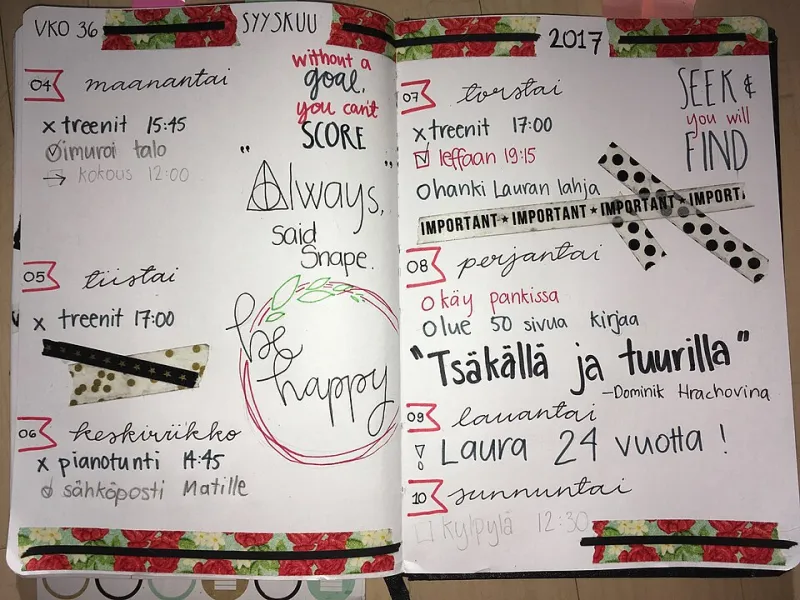
Photo: Walter Tau, CC BY-SA 4.0, via Wikimedia Commons
Flip back through an old journal sometime — not to read the entries, just to look at the pages. Really look at them. Chances are, somewhere between the lined text and the occasional coffee ring, you'll find something else. A cluster of small circles in the corner. A vine crawling up the left margin. A face that appeared while you were thinking about something else entirely. A word written three times, each time slightly differently.
You didn't plan any of it. You probably didn't even notice you were doing it.
But it's there, and it's yours, and it's saying something.
The Doodle as Honest Witness
We tend to think of journaling as a verbal practice — words, sentences, paragraphs, the story of what happened and how we felt about it. But the hand has its own intelligence, and when we're focused on writing, it sometimes slips into a different mode. The pen wanders. Shapes appear. Patterns emerge.
This isn't a malfunction. It's not distraction in any negative sense. What's happening in those margins is a kind of parallel processing — the thinking mind is busy with words while another layer of the self moves freely, uncensored, unedited.
Art therapists have long recognized doodling and spontaneous mark-making as a window into emotional states that don't always translate easily into language. The shapes we make when we're not watching ourselves tend to be more honest than the shapes we make when we are. There's no internal editor for a spiral drawn absentmindedly. There's no performance in a cluster of triangles that appeared while you were trying to describe a difficult conversation.
That's actually kind of remarkable, if you stop to think about it.
Learning to Read Your Own Visual Language
Start paying attention to your margin art over time and you'll probably notice patterns. Most people have a visual vocabulary they return to again and again — certain shapes, certain motifs, certain ways the hand moves when the mind is somewhere else.
Some common things to notice:
Density and pressure. Are the marks light and airy, or are they pressed hard into the page? Heavy pressure often correlates with intensity of feeling — stress, frustration, strong emotion. Lighter marks tend to appear during more reflective, calmer states. Neither is better; both are information.
Repetition and rhythm. Do you fill a margin with the same shape over and over? Repeated patterns can signal a mind working something out — a kind of visual rumination. Notice what you were writing about when the repetition appears.
Placement on the page. Different areas of a page carry different visual weight. Margins filled at the top of an entry, before the words really get going, can feel like a warm-up, a clearing of space. Doodles that appear at the bottom or along the sides after a long entry sometimes feel like a kind of exhale.
Subject matter. If you find yourself drawing faces, eyes, hands, doors, windows, or water repeatedly, those images are worth sitting with. Not in a heavy "what does this symbolize" way — just with a light curiosity. Why that shape? Why now?
The Space Between Writing and Drawing
There's a long history of writers and thinkers who blurred the line between text and image in their notebooks. Leonardo da Vinci's journals are the most famous example — those pages are inseparable collisions of observation, sketch, and written thought, each mode informing the other. Sylvia Plath's journals contain drawings. Frida Kahlo wrote in her diary as much as she drew in it.
The separation between "writing" and "art" is, in many ways, a pretty recent and pretty artificial one. For most of human history, marks on surfaces were all of a piece — communication, expression, decoration, documentation, all tangled together.
Your journal margins are, in their own small way, a return to that older, less divided way of making meaning.
Inviting the Visual In — Intentionally
Once you start noticing your unconscious margin art, you might want to give it a little more room to breathe. Here are a few ways to intentionally incorporate visual elements into your journaling practice without it feeling like an art assignment:
Leave wider margins on purpose. This sounds almost too simple, but it works. When you physically create more white space around your writing, the hand has more room to wander. You'll be surprised what fills in.
Start entries with a shape instead of a word. Before you write a single sentence, make one mark — any mark. A line, a circle, a scribble. Don't think about it. Then write. Notice if the shape you made has any relationship to what you end up writing.
End entries with a visual response. After you finish writing, instead of closing the journal, spend sixty seconds drawing whatever comes — not an illustration of what you wrote, just a response to the feeling of having written it. This is a different kind of reflection than words allow.
Try a "visual word" practice. Pick one word from your entry that carries the most emotional weight and draw it — not in decorative lettering, but in a shape that feels like the word. What does grief look like as a mark? What shape is relief? This sounds a little strange until you try it, at which point it often feels surprisingly natural.
Collect your margin art. Every few weeks, flip through your journal and photograph or trace just the margin doodles — separate from the text. Look at them as a collection. What story do they tell? What patterns show up? This can be genuinely revelatory in a way that re-reading written entries sometimes isn't.
What Gets Said When Words Step Back
There's a particular kind of insight that lives just below the level where language can reach it. We all know this — there are feelings we can circle with words but never quite land on, experiences that resist narration, truths that seem to dissolve the moment we try to describe them directly.
Visual expression, especially the unguarded kind that shows up in journal margins, sometimes gets closer to those wordless places. Not because drawing is inherently deeper than writing, but because it operates through different channels. It bypasses the part of the brain that wants to make sense, explain, justify, narrate.
The doodle in the corner of your journal page didn't go through any of that. It just appeared.
And sometimes the thing that just appears — the mark made without thinking, the shape drawn while the mind was elsewhere — is the truest thing on the page.
So the next time you catch yourself scribbling in the margins, don't brush it off. Don't flip past it. Sit with it for a second. Ask it what it knows.
You might be surprised by the answer.