Dear Future Me: How Journaling Quietly Becomes the Most Honest Mentor You'll Ever Have
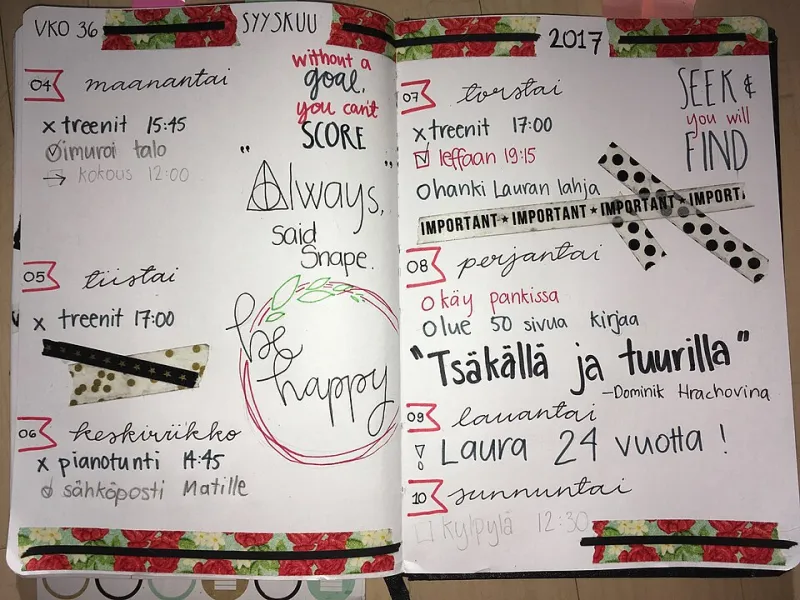
Photo: Txllxt TxllxT, CC BY-SA 4.0, via Wikimedia Commons
There's a specific kind of vertigo that hits when you flip back through an old journal. Maybe it's a notebook you filled two years ago, maybe five. The handwriting looks like yours but the person behind it feels almost foreign — anxious about things that resolved themselves, certain about things that turned out to be completely wrong, and somehow, inexplicably, saying exactly what you needed to hear right now.
That's not coincidence. That's time travel.
Not the sci-fi kind with wormholes and paradoxes. Something quieter and, honestly, more useful: the way consistent journaling creates a living dialogue across different versions of yourself. Past entries become counsel. Present writing becomes a letter to a self you haven't met yet. And somewhere in the middle of all that, you become your own most reliable mentor.
The Weird Way Time Works Inside a Journal
When we think about journaling, we tend to think of it as a one-directional act — you sit down, you write, you close the cover, done. But that framing misses the most interesting part of what's actually happening.
Psychologists who study autobiographical memory have found that the act of narrating your own experience doesn't just record it — it reshapes it. When you write about something that happened to you, you're not transcribing a file. You're actively constructing meaning, deciding what matters, and creating a version of events that your brain will return to as the "official" story. That's powerful. It means journaling isn't passive documentation. It's authorship.
And here's where it gets interesting: that authorship travels. The self who writes an entry in January is planting something for the self who reads it in October. Not intentionally, most of the time. But the act of articulating something — a fear, a hope, a half-formed plan — gives it a shape that can be recognized later. You're essentially leaving breadcrumbs for a version of yourself who doesn't yet exist.
Reading Old Entries Feels Like Getting Advice From Someone Who Knew You
There's a reason therapists sometimes ask clients to journal. Part of it is processing. But another part is creating distance — the kind of perspective that's almost impossible to access when you're deep inside a difficult moment.
When you read what you wrote six months ago, you're no longer inside that moment. You're a witness to it. And witnesses see things participants can't.
Maybe you wrote about a relationship that felt confusing and described, without realizing it, exactly the dynamic that was hurting you. Maybe you wrote about a career decision and buried in the third paragraph was the clearest articulation of what you actually wanted — the thing you've been trying to figure out ever since. Past-you knew. You just needed the time gap to hear it.
This is what makes journaling different from just thinking. Thoughts are slippery. They loop, contradict, and dissolve. But written words stay. They hold their shape. They wait.
Writing to a Self You Haven't Become Yet
Flip the dynamic around, and something equally interesting happens. When you journal with some awareness that future-you will one day read this, the writing changes. It gets a little more honest. A little more generous. You start to write the way you'd talk to someone you genuinely care about, someone you want to succeed.
Some journalers do this explicitly — writing letters addressed to themselves five or ten years out. It's a practice that shows up in a lot of personal development circles, but the value isn't really about goal-setting or manifestation. It's about the quality of attention you bring to your own life when you treat it as a story worth telling.
When you write to future-you, you're forced to articulate where you actually are right now. Not the curated version you'd post anywhere public. The real version — the uncertainty, the small victories, the things that are quietly falling apart and the things that are quietly clicking into place. That kind of honesty is rare. And it's exactly the kind of record that becomes genuinely useful later.
The Self-Mentorship Loop
Here's what all of this adds up to: a loop. You write, time passes, you read, you write again — and somewhere in that cycle, you start to accumulate something that functions a lot like wisdom.
Not wisdom in the grand, capital-W sense. More like: pattern recognition about your own behavior. The ability to notice when you're in a familiar emotional weather pattern. The capacity to remember, even when you're convinced you've never felt this way before, that actually you have — and here's what helped.
This is what a good mentor does. They hold your history when you can't. They reflect it back to you at the right moment. They remind you of your own capabilities when you've temporarily forgotten them. Your journal, over time, does all of this. It becomes the most complete record of your inner life that exists anywhere.
No one else has access to that record. No one else could mentor you from it the way you can mentor yourself.
Starting the Conversation
If you've never thought about your journaling practice this way, it might feel a little abstract. So here's something concrete: the next time you sit down to write, try ending your entry with a single line addressed directly to whoever reads it next. It might be you tomorrow. It might be you in three years.
Something like: I hope by the time you read this, you've stopped being so hard on yourself about this. Or: I wonder if you figured out what you actually wanted. Or just: Hey. You made it.
It sounds small. But it does something to the writing — it makes it feel like it matters, like it's going somewhere, like it's part of a longer story that hasn't finished yet.
Because it is. You're not just keeping a journal. You're keeping a conversation alive across time. And that conversation, if you let it, will tell you more about who you are — and who you're capable of becoming — than almost anything else.