7 Journaling Prompts That Will Crack Open Stories You Didn't Know You Were Living
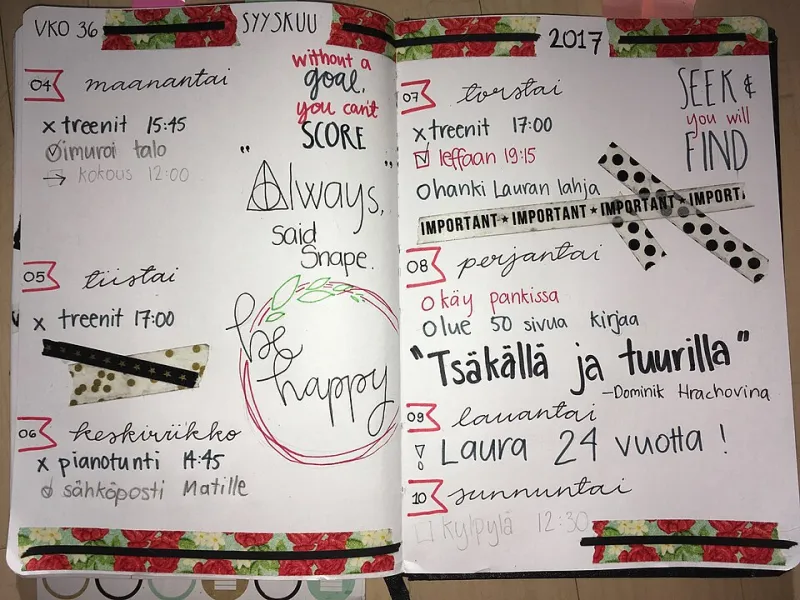
Photo: Nea.salo, CC BY-SA 4.0, via Wikimedia Commons
Here's the thing about journaling that nobody tells you upfront: the entries that change you are almost never the ones you planned to write.
You sit down intending to process a bad week, and somehow you end up writing three pages about a summer you spent at your grandmother's house in rural Tennessee when you were nine. You start with "I'm stressed about work" and end up at something that feels uncomfortably true about who you've become.
That's not an accident. That's stream of consciousness doing its thing.
Stream of consciousness journaling isn't about being a good writer. It isn't about grammar, or structure, or even making sense. It's about writing fast enough that your inner critic — that careful, self-editing voice that keeps things tidy and presentable — can't keep up. When you outrun that voice, what comes out is usually something worth reading.
These seven prompts are designed specifically to do that. Each one is a side door into your own story.
Before You Start: The Only Rule
Set a timer. Ten to fifteen minutes per prompt is plenty. Write without stopping, without re-reading, without crossing anything out. If you get stuck, write "I don't know what to say" until something else comes. It will. Don't think about whether it's true or fair or flattering. Just write.
Okay. Let's go.
Prompt 1: "The version of me that nobody sees is..."
This one hits differently than it looks. Most people expect to write something vulnerable but safe — "the version of me nobody sees is really tired" or "really ambitious." But if you keep going past that first comfortable answer, you'll usually find something more specific and more surprising.
One reader, a high school art teacher from Columbus, Ohio, started this prompt thinking she'd write about her anxiety. Instead, she ended up writing four pages about a secret ambition to move to New Mexico and make ceramics full time — a desire she'd been quietly burying for almost a decade. "I didn't even know I'd decided not to do it," she said. "I just wrote my way into realizing I had."
The hidden self isn't always dark. Sometimes it's just unacknowledged.
Prompt 2: "I learned that I was _______ the day that..."
Fill in the blank with whatever comes first — brave, selfish, a good friend, a coward, capable, broken, resilient. Then write the story of that day.
What this prompt does is force a narrative. You're not just describing a quality you think you have; you're anchoring it in a specific memory. And specific memories are where the real material lives. Vague self-descriptions rarely teach us anything new. But the specific afternoon you stood up for yourself in a meeting, or the specific moment you didn't — those carry information.
This prompt is particularly good for people who feel like they don't have interesting stories. Everyone has the day they learned something true about themselves. You just have to find it.
Prompt 3: "The conversation I keep having in my head is..."
We all have them. The argument you're rehearsing. The explanation you want to give. The thing you wish you'd said. The apology you're waiting for.
Writing out that internal conversation — actually scripting it like a scene, with dialogue — can be revelatory in two directions. Sometimes you realize the conversation is something you actually need to have with a real person. Sometimes you realize you've been having it with yourself all along, and the other person is almost beside the point.
A writer in Seattle used this prompt and ended up scripting a forty-five-minute imaginary conversation with her late father. "I found out what I was actually angry about," she wrote afterward. "It wasn't what I thought it was."
Prompt 4: "When I imagine my life ten years from now, the part I'm afraid to say out loud is..."
Future-self prompts are common in journaling, but most of them are aspirational — where do you want to be, what do you hope to achieve. This one goes somewhere different. It asks specifically for the fear-adjacent wish. The thing you want that feels too fragile, too unrealistic, or too revealing to admit.
Because here's the truth: the dreams we don't say out loud are often the ones we actually care about most. The ones we do say out loud have usually been pre-approved by our inner committee of practical concerns. This prompt bypasses the committee.
Write fast on this one. Don't let yourself edit.
Prompt 5: "The story I tell about my childhood that isn't quite right is..."
We all have a personal mythology — a set of stories about where we came from that have been told enough times they've calcified into fact. The difficult family, the formative friendship, the defining loss. These stories are real, but they're also edited. Time-compressed. Made meaningful in retrospect.
This prompt asks you to look at one of those stories sideways. Not to deconstruct it or decide it's wrong, but to notice where the edges are soft. Where you might have simplified something complex, or made yourself the hero or the victim in a way that's a little too clean.
This one can be uncomfortable. That's usually a sign it's working.
Prompt 6: "Something I've never written about is..."
Simple. Direct. And consistently one of the most productive prompts in any journaling practice.
There are things we keep off the page even in our most private writing. Subjects that feel too heavy, too embarrassing, too unresolved. This prompt doesn't demand you write about that thing in full — it just asks you to name it. And then, if you keep going, to write whatever comes next.
Sometimes naming the thing is enough. Sometimes the door opens and you walk through it. Either way, you've made contact with something real.
Prompt 7: "If my life were a book, the chapter I'm in right now would be called..."
End with this one. It's both reflective and forward-looking, and it asks you to do something genuinely creative: find the narrative shape of your current experience.
Chapter titles are interesting because they require compression and meaning simultaneously. "The Winter Everything Fell Apart" tells you something different than "The Year I Started Over" even if they're describing the same calendar period. The title you choose — and the one you almost chose — will tell you something about how you're holding your own story right now.
One reader described her current chapter as "Still Waiting for the Plot to Pick Up." She laughed writing it, then cried a little. "That felt more honest than anything I'd written in years," she said.
What You Do With What You Find
Some of what comes out of these prompts will be raw and unfinished. That's fine. You don't have to do anything with it immediately. The point of stream of consciousness journaling isn't to produce polished content — it's to make contact with what's actually happening inside you.
But over time, if you return to these pages, you'll start to see patterns. Recurring images. Themes that surface again and again. Characters — including yourself — who are more complicated than you'd realized.
That's the real gift of this kind of writing. Not the individual entry, but the portrait that accumulates over months and years of honest, unguarded pages.
Your life is already full of stories worth telling. Sometimes you just need the right question to find them.