What the Blank Page Is Actually Saying: Learning to Stop Before the Journal Is Full
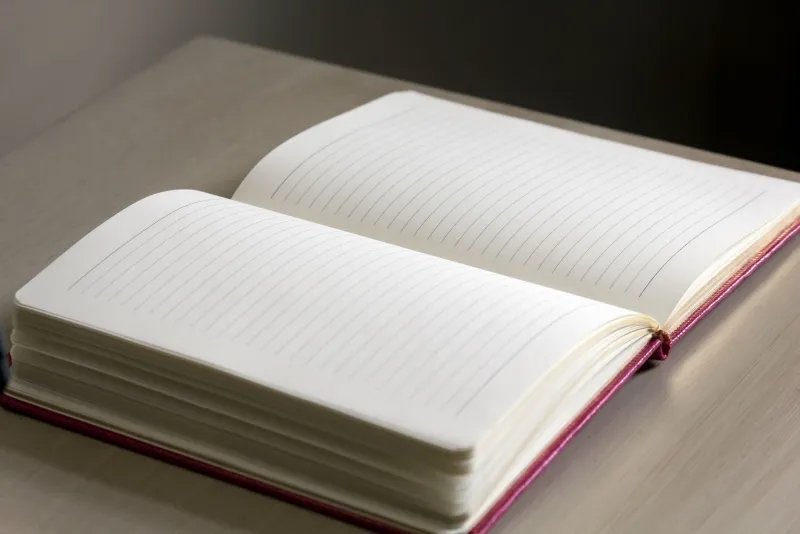
Somewhere along the way, most of us picked up the idea that a good journal entry means a full page. Ink from margin to margin. Every corner accounted for. If there's white space left over, it feels like you didn't try hard enough, like you left the story unfinished.
But what if the white space is the story?
There's something worth sitting with here — the way we fill our journals is often a mirror of how we fill our lives. Cramming every line. Squeezing in one more thought before bed. Never quite letting a moment breathe before we've already moved on to interpreting it. The journal becomes less a place to reflect and more a place to perform reflection, which is a sneaky kind of trap.
Leaving space — intentionally, deliberately — is harder than it sounds. And that difficulty tells you something.
The Anxiety Behind the Full Page
There's a particular kind of restlessness that shows up when you close a journal on a half-written page. It feels unresolved. Almost rude, like hanging up the phone mid-sentence. American productivity culture doesn't help here — we're wired to equate output with worth, even in our most private spaces. A sparse entry can feel like evidence of a slow day, a lazy mind, a life not quite interesting enough to fill the page.
But that feeling? That slight discomfort when you cap your pen and there's still room left? That's exactly the sensation worth exploring.
Because outside of your journal, that same discomfort shows up everywhere. In the conversation you kept talking through instead of letting sit. In the creative project you kept revising past the point it needed you. In the relationship where you gave a little more than you actually had, just to avoid the awkward quiet of not filling the space.
The journal is just where you can finally see it clearly.
What Restraint on the Page Actually Practices
When you leave a wide margin, you're doing something physically small but psychologically significant: you're trusting that what's already there is enough. You're deciding not to hedge. Not to over-explain. Not to squeeze in the caveat, the footnote, the second-guessing.
That's a muscle. And like any muscle, it gets stronger the more you use it.
Some people find it helpful to set a loose rule — write until the thought feels complete, then stop, even if there are three blank lines staring back at you. Others leave the bottom quarter of every page intentionally empty, almost like a visual exhale. Some skip a full page between entries, giving each day its own breathing room rather than letting Tuesday bleed directly into Wednesday.
None of these are productivity hacks. They're more like rehearsals for a version of yourself who knows when enough is enough.
The Unfinished Thought as an Act of Faith
Here's something that might feel counterintuitive: letting a journal entry trail off mid-thought isn't abandonment. It can actually be one of the more honest things you do on the page.
Not every feeling resolves neatly by the time you close the notebook. Not every question has an answer waiting in the next paragraph. Sometimes the most accurate thing you can write is half a sentence followed by open space — because that's exactly where you are. You're mid-thought. Mid-process. And that's real.
There's a kind of self-trust embedded in that choice. You're saying: I don't need to manufacture a conclusion right now. I'll let this one breathe. And then — this is the part that tends to surprise people — you come back to the journal a week later and find that the thought finished itself somewhere in the background, quietly, without you forcing it.
The page held space for it. Your mind did the rest.
How the Journal Teaches the Life
This is where the practice gets genuinely useful beyond the notebook.
When you get comfortable leaving space on the page, something starts to shift in the spaces outside of it. You get a little better at ending the conversation before it loops for the third time. At sending the email without the extra paragraph you almost added. At finishing a creative project and actually calling it done instead of fiddling with it for another two weeks.
You start to recognize the feeling of enough — which is a feeling a lot of us have been trained to distrust.
Wide margins in your journal can quietly become wide margins in your relationships. That gap between what someone says and your response — the one where you actually think instead of react. The pause before you agree to something you don't have energy for. The moment where you let someone else's silence just be silence instead of rushing to fill it.
None of that comes naturally in a culture that treats every pause as a problem to solve. But the journal gives you a low-stakes place to practice.
A Different Kind of Completeness
There's a Japanese aesthetic concept called ma — roughly translated as negative space, or the meaningful pause between things. It shows up in music, architecture, conversation. The idea is that the space between notes is part of the composition, not just the absence of sound.
Your journal can work the same way. The blank half-page isn't a failure to fill it. The unfinished sentence isn't a loose thread. They're part of the composition of who you are right now — someone still in the middle of figuring things out, someone honest enough to admit it, someone who's learning that not everything needs to be said to be true.
That's not laziness. That's a kind of editorial wisdom most of us take years to develop.
So the next time you finish a thought and there's still space left on the page — just leave it. See how that feels. Notice the small twitch of anxiety, acknowledge it, and put the pen down anyway.
The blank space isn't empty. It's waiting.