When You Pick a Fight With Your Past Self: The Unexpected Power of Re-Reading Your Journals

There's a particular kind of discomfort that comes from cracking open a journal you haven't touched in two years. Not the nostalgic, soft-focus kind of discomfort — the prickly kind. The kind where you read a sentence you wrote with complete conviction and think, who even was that person?
Here's the thing though: that reaction isn't embarrassment. It's evidence.
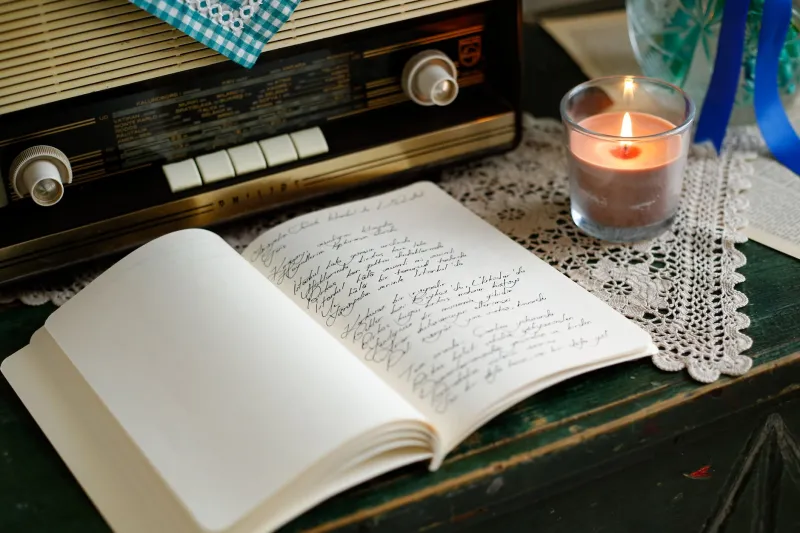
Most of us treat our journals like time capsules — sealed containers of a moment, preserved and set aside. We write, we close the cover, we move on. But the real creative and psychological magic of keeping a journal doesn't happen when you're writing. It happens when you come back.
Because when you return to those pages, you're not just reading. You're arguing.
The Conversation You Didn't Know You Were Starting
Every journal entry is, in some way, a thesis statement. You were working something out — a feeling, a decision, a version of a story you needed to believe at the time. And like any thesis, it holds up until someone challenges it.
That someone, eventually, is you.
When you re-read an old entry and feel that flicker of yeah, but... — that's not you dismissing your past self. That's a genuine intellectual exchange happening across time. Your present self has new data. New experiences, new heartbreaks, new wins. And it's bringing all of that to the table when it sits down with something you wrote three years ago about why a certain job wasn't worth fighting for, or why a specific relationship was definitely fine.
This is what makes the journal archive so much richer than a simple record. It's not a museum. It's a debate floor.
Why Your Past Self Is Actually a Worthy Opponent
Here's where it gets interesting: your past self wasn't wrong just because you disagree with them now. Sometimes you re-read an entry and realize, uncomfortably, that the version of you from 2021 had a clearer read on a situation than the version of you who's been slowly rationalizing things ever since.
That's the part nobody talks about enough. Re-reading your journals doesn't just reveal growth. It reveals the places where you've drifted away from something true. Where you've talked yourself out of an instinct that was actually solid. Where you've let time and social pressure and convenience quietly rewrite your own internal record.
Your past self, at their best, was unfiltered. They hadn't yet learned to package their feelings in more socially acceptable language. And sometimes that rawness is more accurate than everything that came after it.
So when you go back to those pages, go back ready to listen, not just to judge.
The Patterns You Can Only See From a Distance
One of the strangest things about living inside your own mind is that you genuinely cannot see your own patterns while you're in them. It's like trying to read a billboard when you're standing two inches away from it.
But distance — even just a year or two of it — changes everything.
When you read across multiple entries instead of just one, you start to notice things. The same anxiety showing up in different costumes. The same kind of person you keep describing with the same kind of language. The same fork in the road you keep arriving at and taking the same turn on, even when you swore last time that you wouldn't.
This is information you genuinely cannot get any other way. Therapy helps. Talking to friends helps. But there's something uniquely powerful about seeing your own handwriting — or your own typing — lay out a pattern that you've been living inside of without ever naming it.
The journal archive, read as a whole, becomes something like a behavioral map. And maps, however uncomfortable they are to look at, tell you where you actually are.
How to Actually Do This (Without Spiraling)
Re-reading old journals can go sideways fast if you approach it like a performance review. You're not there to grade yourself. You're there to meet yourself — past and present — somewhere in the middle.
A few things that help:
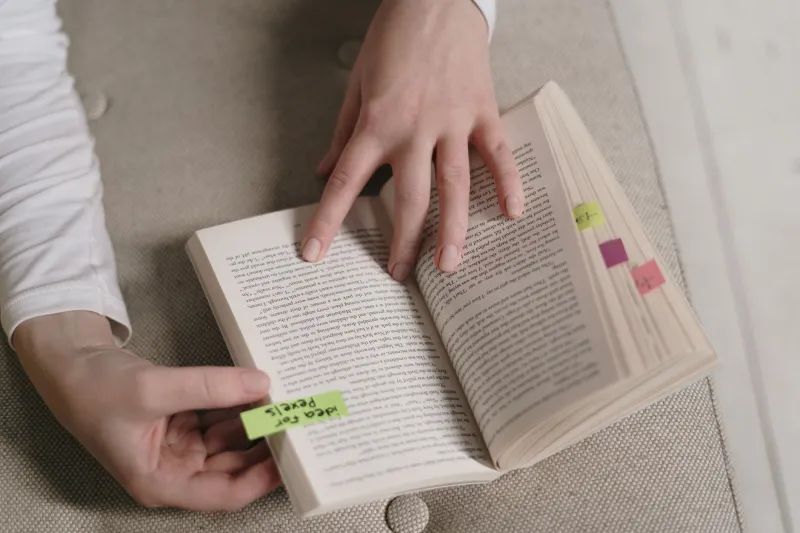
Read with a pen in hand. Don't just consume the old entries passively. Write back. Literally respond in the margins or in a new entry. "I wrote this because..." or "What I know now that I didn't then..." or even just "Still true." The act of responding keeps you in dialogue mode rather than judgment mode.
Look for the emotional subtext, not just the content. What you wrote about matters less than how you wrote about it. Were you performing calm when you were clearly terrified? Were you minimizing something that took up three pages? The tone of an old entry often tells you more than the words themselves.
Notice what surprises you. The entries that make you go huh, I forgot I thought that are the most valuable ones. Surprise means you've moved. It means the gap between then and now is real and measurable. That's worth sitting with.
Don't skip the cringe. The entries that make you want to close the notebook are almost always the ones worth reading most carefully. The cringe is usually pointing at something — a belief you outgrew, a version of yourself you've been quietly ashamed of, a decision you've never fully processed. Let it point.
The Self-Deception Audit
Here's the part that takes some courage: sometimes re-reading your journals reveals not just growth, but the specific shapes of your self-deception.
Maybe you wrote about a situation in a way that made you the obvious hero and everyone else the obvious villain — and reading it now, with more distance, you can see exactly where you were protecting yourself from a harder truth. Maybe you wrote about being totally fine with something in language so insistent that it's practically screaming how not-fine you actually were.
This isn't about beating yourself up. It's about developing what you might call narrative honesty — the ability to tell your own story without the usual edits and flattering filters. And the only way to develop that skill is to catch yourself in the act of not doing it.
Your old journals are the receipts. Not to hold against yourself, but to learn from.
Your Archive Is Alive
The most useful shift you can make is to stop thinking of your journal collection as a finished record and start thinking of it as an ongoing conversation. One that started the day you wrote your first entry and won't end until you stop writing entirely.
Every time you go back, you bring a different version of yourself to the table. And every time, the pages give you something different back — because you're different, and that changes what you're able to see.
That old notebook isn't just storing your past. It's waiting to tell you something about your present that you haven't figured out how to ask yet.
Go pick a fight with yourself. You might be surprised who wins.