Every Underline Is a Self-Portrait: What Your Arguments With Books Say About Who You're Becoming
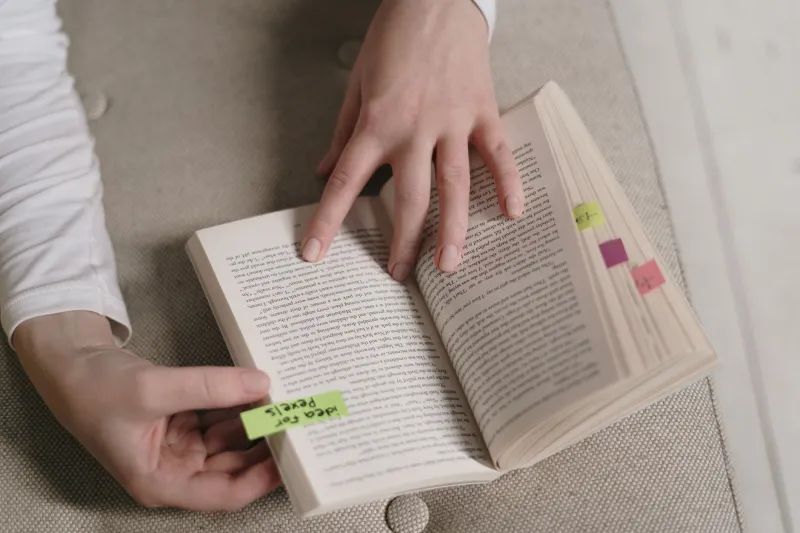
Somewhere on your bookshelf — maybe wedged between a novel you swear you'll finish and a self-help title you bought during a weird month — there's a book with your handwriting in it. A circled paragraph. A question mark so aggressive it practically went through the page. Maybe a single word: really? Or yes. Or, if you were having a particularly opinionated afternoon, a full rebuttal scrawled sideways in the margin like a tiny manifesto.
Most people think of annotation as a study habit. Something students do under fluorescent lights before exams. But what if all that talking back to books — the stars, the underlines, the impatient little arrows — is actually a form of journaling you've been doing without realizing it? What if your margins are where your most unfiltered, unperformed self has been showing up all along?
The Book That Made You Argue Back
Think about the last time a sentence in a book made you physically react. Maybe you exhaled sharply. Maybe you put it down and stared at the ceiling. Maybe you grabbed a pen and wrote something like this is exactly wrong — or, more unsettling, this is exactly me.
That reaction isn't random. It's your value system bumping up against someone else's. When an author makes a claim that irritates you, you're not just registering disagreement — you're revealing what you believe strongly enough to defend, even in private, even when no one's watching. There's something almost purer about margin notes than journal entries, actually. Journal entries know they're being written. Margin notes don't. They're reflexive. Instinctive. They're you before you've had time to perform yourself.
And the ones that make you stop and write yes, this with three underlines? Those are the sentences that articulate something you felt but hadn't found language for yet. Someone else's words becoming the key to a room inside you that was already there, just locked.
What Different Marks Actually Mean
If you're a habitual annotator, you've probably developed your own visual language without consciously designing it. A single underline might mean interesting. A double underline might mean I need to come back to this. Stars tend to appear next to things that feel important in a way you can't explain yet. And the full-margin rebuttals — those paragraphs you wrote in tiny letters because you ran out of space — those are where the real gold is.
Look at the difference between what you underline versus what you argue with. The things you underline are often the ideas you're absorbing, the ones you want to carry with you. The things you argue with are the ideas that threaten something — a belief, an identity, a story you've been telling yourself. Both categories are self-portraits. But the arguments are where you find out what you're actually protecting.
There's also the category of passages you marked and now can't remember why. You flip back to a highlighted sentence and think: what was I seeing in this? That gap — between the person who made the mark and the person reading it now — is where the real reflection happens.
Time-Lapse of a Changing Mind
Here's the practice worth trying: pull out an annotated book you haven't opened in at least a year, ideally longer. Don't re-read it cover to cover. Just read your own notes.
Notice which arguments you'd still make. Notice which ones make you cringe a little — not because you were wrong, exactly, but because you can see how much smaller or more certain you were back then. Notice the passages you starred that no longer move you, and the ones you barely marked that now seem like the whole point of the book.
This is a time-lapse of your mind. Not a filtered, narrative version of who you were — the kind you'd write in a journal entry — but a raw, in-the-moment record of what was landing and what was bouncing off. The you who made those marks wasn't trying to document themselves. That's what makes it trustworthy.
One woman I know went back to a memoir she'd heavily annotated during her mid-twenties and found that almost every passage she'd starred was about ambition, external validation, and proving something to people who hadn't been paying attention. By the time she re-read it in her early thirties, those were the sections that felt the most foreign to her. What she'd underlined without much fanfare — the quieter passages about ordinary contentment — were the ones that now felt like prophecy. Her margins had documented the whole shift without her realizing she was documenting anything.
How to Make This a Practice
You don't need to become a completionist annotator to make this work for you. Even selective marking — a few honest reactions per book — builds up into something meaningful over time. The key is permission. Give yourself permission to disagree out loud on the page. To write I don't buy this or who is this actually for? To argue with a Nobel laureate or a beloved classic or the bestseller everyone seems to love except you.
Your disagreements are not disrespectful. They're evidence that you're in actual conversation with the text rather than just processing it. And a conversation requires two real participants — which means you have to show up as yourself, not as a polite, agreeable reader who's afraid to push back.
If you want to deepen the practice, try dating your annotations. Even just writing the year in the front of the book before you start reading creates a timestamp that makes the future re-read exponentially more interesting. Some people add a brief note at the end of the book — not a review, just a line or two about where they were in their life when they read it. That context turns the book into a capsule.
The Shelf as Archive
At some point, if you keep this up, your bookshelf becomes less a collection of other people's ideas and more a personal archive. Each annotated spine is a record of an encounter — between you and an argument, between you and a worldview, between you and a version of yourself that existed during a specific window of time.
That shelf is a kind of autobiography. Not the curated kind you'd write intentionally, but the accidental kind — made up of reflexes, resistances, recognitions, and the occasional scrawled absolutely not that tells you more about your own convictions than any journal prompt ever could.
So the next time a book makes you want to argue back, grab a pen. Write something real in the margin. Your future self will thank you for the honesty.