Torn Edges and Train Tickets: How the Scraps You Save Are Actually Writing Your Life Story
There's a small zippered pouch on my desk that has no business existing. Inside it: a Metrocard from a New York trip I took three years ago, a price tag from a thrift store dress I wore to a concert, two dried rose petals that have mostly crumbled into dust, and a fortune cookie slip that reads you are almost there. Almost where? I genuinely don't remember. But I can't throw any of it away.
Most of us have a version of that pouch. A shoebox. A kitchen drawer. A back pocket of a tote bag. We hold onto things that have no practical use — ticket stubs, sugar packets from memorable cafés, fabric swatches, polaroids with slightly blown-out exposure — because something in us understands, even wordlessly, that these objects are doing a kind of memory work that language alone can't quite finish.
When you start bringing those scraps into your journal — gluing, taping, layering them alongside your words — something shifts. The page stops being a record of your life and starts becoming a texture of it.
Why Physical Objects Remember Things Your Brain Doesn't
Here's something kind of wild: the smell of a movie theater stub or the specific weight of a foreign coin can unlock memories that sitting down and trying to remember simply won't surface. Researchers call this phenomenon context-dependent memory — our brains encode experiences alongside the sensory details that surrounded them, so a physical artifact from that moment can act almost like a key.
When you tape a torn-off corner of a coffee shop napkin into your journal and write around it, you're not just decorating a page. You're creating a multi-sensory anchor. Future you — flipping back through that journal months or years from now — won't just read about that afternoon. You'll feel the rough paper texture, notice the faint coffee ring still visible on the edge, and suddenly you're closer to actually being there than any paragraph could take you.
Typed words on a screen are clean and searchable and convenient. But they are also, in a very real way, weightless. A physical object carries its own history in ways that pixels simply don't.
The Quiet Art of Arrangement
Here's where journaling with ephemera becomes something more than scrapbooking (not that there's anything wrong with scrapbooking — but stay with me). When you sit down with a handful of scraps and a journal page, you have to make choices. What goes where. What overlaps what. Whether the receipt goes corner-up or flat. Whether the photo is centered or tucked under the edge of something else.
Those choices are a form of storytelling. You're not just preserving — you're interpreting. The way you arrange objects on a page reveals something about how you feel about the experience they came from. A chaotic, layered collage of overlapping concert stubs and handwritten setlists says something emotionally different than a single, carefully placed ticket with one clean line of text beside it.
This is why art therapists have long used collage as a tool for processing emotion. When we can't find the words for how something felt, our hands sometimes know what to do. The arrangement becomes the sentence.
The Receipts We Keep Are Portraits of Our Priorities
There's also something genuinely revealing about which ephemera you choose to save. Think about it: you probably throw away ninety percent of the paper that passes through your hands on any given day. The things that end up in your journal — or in that mysterious desk pouch — made some kind of cut. Why?
A grocery receipt from the week you moved into your first apartment. A ticket stub from the last movie you saw with someone who's no longer in your life. A paint chip card from the hardware store when you were trying to decide on a bedroom color. These aren't random. They're artifacts of decision-making, transition, connection, and change. Collected together in a journal, they form a kind of autobiography that is almost embarrassingly honest — not because you wrote your feelings down, but because your choices about what to keep are already telling the story.
In that way, an ephemera journal becomes less like a diary and more like an archaeological dig of the self.
Getting Started Without Overthinking It
If you've never tried this and the whole concept feels a little precious or crafty in a way that's not quite you, here's a low-stakes way in: just start keeping a small envelope or pocket in your current journal. Don't glue anything yet. Just collect. Toss in the things that feel meaningful, even if you can't explain why.
After a week or two, spread them out on a table. Notice what surprised you about what you kept. Notice what stories start to form just from looking at the pile together. Then, if you feel like it, start placing them on pages. You don't need a bone folder or fancy washi tape or any of the gear that journaling corners of the internet might have you believe are required. A glue stick and a Sharpie are genuinely enough.
Some people like to write around their ephemera, letting the objects interrupt and anchor the prose. Others prefer to let the objects speak mostly on their own, adding just a date or a single phrase. There's no wrong version. The point is that the page starts to hold more than language — it holds dimension.
The Thing About Impermanence
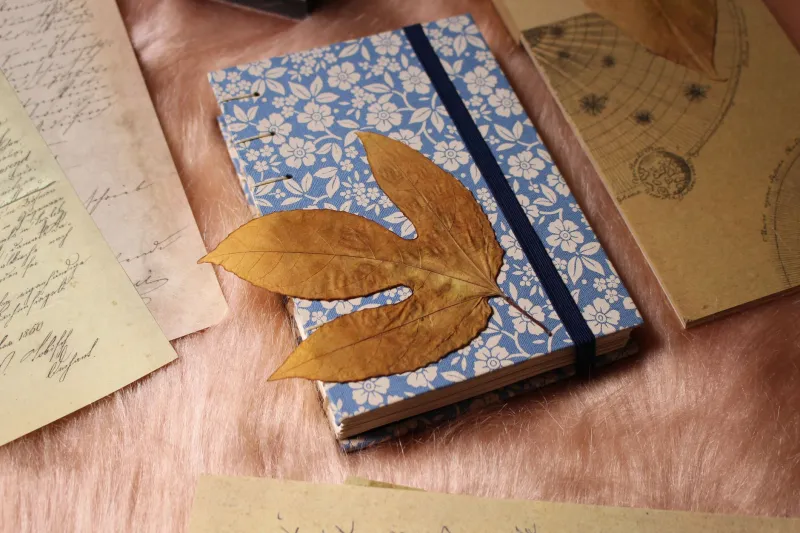
Some of the most beautiful ephemera journals are also the most fragile. Pressed flowers eventually brown and crumble. Ink on old receipts fades to near-invisibility within a few years (thermal paper is genuinely terrible for archiving — worth knowing). Polaroids yellow. This impermanence is, in a strange way, part of the point.
The journal isn't meant to be a perfect preservation. It's meant to be a living document — one that ages alongside you, that shows the passage of time in its own physical decay, that holds the evidence of a life actually being lived rather than curated for an audience.
That crumbling rose petal is more honest than any highlight reel. That faded receipt, barely legible, still means something — maybe more, now, because of what time has done to it.
The scraps we save are not clutter. They're the parts of our story that didn't fit neatly into words. And when you give them a home on the page, you're not just making a pretty journal — you're admitting, in the most tactile way possible, that your life is worth documenting in full. Messy edges, coffee stains, and all.