Who Are You Writing For? The Private Page vs. the Public Post
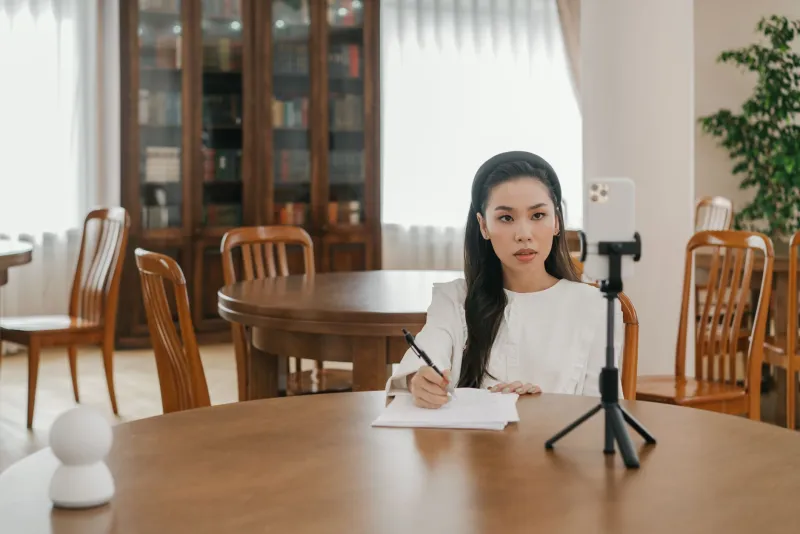
There's a version of journaling most of us grew up with — a notebook tucked under a mattress, a lock on the cover, ink that felt sacred precisely because no one else would ever see it. And then the internet happened. Then Instagram happened. Then the entire genre of the "aesthetic journal spread" showed up on TikTok and suddenly, the act of writing privately started existing in very public conversation.
None of that is inherently bad. But it does raise a question worth sitting with: Who are you writing for when you open your journal?
The answer shapes more than you might realize.
The Invisible Audience Effect
Psychologists have a term for what happens when we believe we're being observed — even when we're not. The "imaginary audience" phenomenon, originally studied in adolescent development, doesn't disappear when we grow up. It just gets quieter and more sophisticated.
When you've spent years consuming other people's curated journal pages online — the beautifully lit spreads, the vulnerability-as-content, the perfectly phrased emotional revelations — something subtle happens to your own writing practice. You start editing yourself before you've even begun. You reach for the phrasing that sounds honest rather than the thought that actually is honest. You write toward an aesthetic instead of toward a truth.
This isn't a character flaw. It's just what happens when we're cultural creatures swimming in a sea of performance. The trick is learning to notice it.
What Privacy Actually Unlocks
Here's something worth considering: the most uncomfortable thought you had this week — the one you haven't told your best friend, your therapist, or your partner — that's probably the one that most needs a page.
Private journaling creates a container that public writing simply can't replicate. There's no approval to seek, no misunderstanding to preemptively defend against, no imagined reader flinching at your honesty. It's just you and the mess of being human. And in that unguarded space, people tend to discover things about themselves that polished, audience-aware writing never surfaces.
Research from psychologist James Pennebaker has consistently shown that expressive writing — particularly writing about difficult emotional experiences — has measurable benefits for mental and physical health. But those benefits are most pronounced when the writing is genuinely uninhibited. When people write knowing it will be read, their language shifts. They explain more. They justify. They perform coherence even when coherence isn't what they're actually feeling.
In other words, privacy isn't just a preference. It's a functional ingredient in what makes journaling work.
The Case for Sharing Anyway
None of this means that sharing your writing is wrong, or even counterproductive. Plenty of people have built meaningful communities — and meaningful self-understanding — through the practice of writing publicly.
The journal-as-newsletter has become its own genre. Substack writers share vulnerable personal essays and find that the act of articulating their experience for an audience actually clarifies it. Some people find that the accountability of sharing keeps them writing consistently when private pages collect dust. And there's something genuinely valuable about offering your honest experience to someone else who might need to feel less alone in theirs.
The key distinction isn't private good, public bad. It's about being honest with yourself about which mode you're operating in — and making sure you have at least some space that's entirely unperformed.
The Hybrid Life Most of Us Are Actually Living
Let's be real: most people reading this are probably doing both. You've got the notebook no one sees, and you've also maybe shared a journal-style post on Instagram, or written something personal on a blog, or texted a friend a paragraph that started as a journal entry.
That's fine. That's actually pretty healthy, as long as you're not accidentally letting the public mode colonize the private one.
One way to protect that boundary is to keep the two practices physically or digitally separate. Your private journal — whether it's paper or a password-protected app — stays off-limits for repurposing. What lives there, lives there. If something eventually feels ready to share, you can write a new version of it for an audience. But the raw original stays yours.
This matters because the moment you start writing with even a background awareness that something might be shared, the writing changes. Not always for the worse — but always in ways that move it away from pure self-exploration.
The Vulnerability Paradox
Here's the strange irony at the center of all this: the writing that feels most vulnerable in private is often the writing that resonates most when shared. The unpolished, un-PR'd version of your interior life is, paradoxically, what other people find most recognizable and moving.
But you can't manufacture that quality by trying to write vulnerably for an audience. It only exists when you write vulnerably for yourself — and then occasionally, carefully, choose to let someone else in.
The writers and creators who manage this well tend to have the same quality: they clearly have an inner life that exists independent of whether anyone is watching. Their public writing feels like a window into something real, not a stage set built to look like something real.
You can tell the difference. And so can your readers, if you ever choose to have them.
Reclaiming the Page That's Just Yours
If you've been journaling primarily in public-facing formats — or if you've noticed that your private writing has started to feel a little too polished, a little too ready for an audience — it might be worth deliberately creating a space that's messier and more protected.
Write something you'd never post. Write something that doesn't resolve neatly. Write something that contradicts what you said last week. Write something embarrassing, petty, grieving, or uncertain — without the instinct to frame it into a lesson.
That's the journal that does the real work. Not because messy is better than beautiful, but because yours is better than performed.
The page that no one sees is still doing something. Maybe it's doing the most important something of all.