Cracking Open the Archive: What Your Old Journals Are Still Trying to Tell You
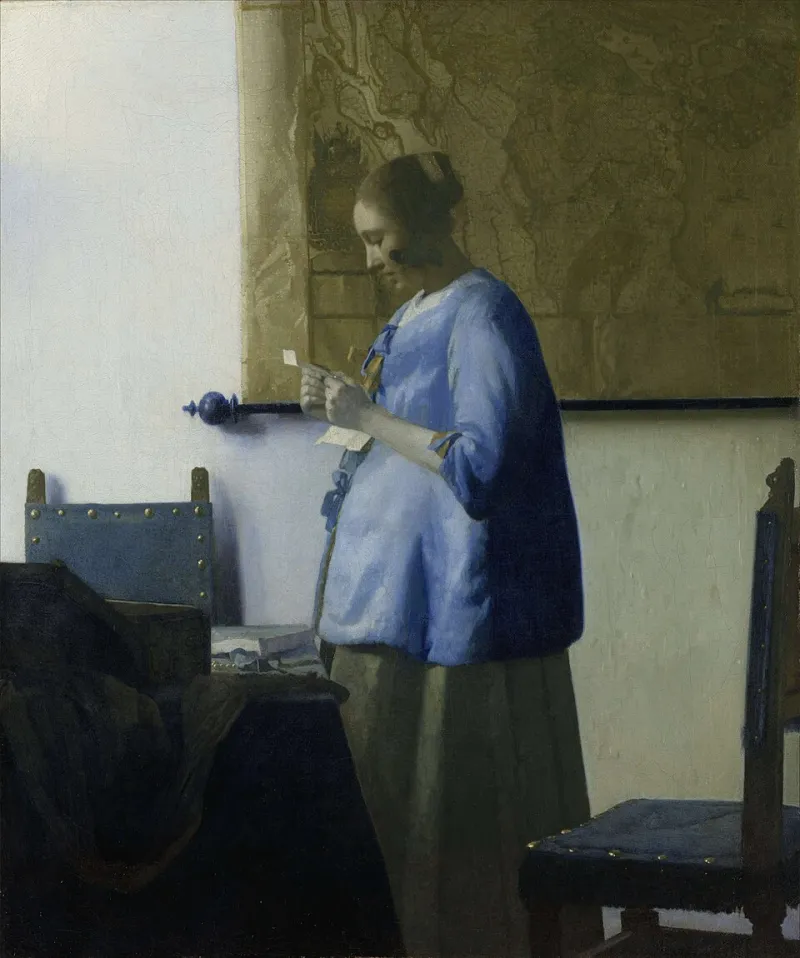
Photo: Johannes Vermeer, Public domain, via Wikimedia Commons
There's a specific kind of courage it takes to open an old journal. Not the dramatic, movie-montage kind of courage — more like the quiet, slightly-nervous-in-your-stomach kind. You crack the cover, read a few lines, and suddenly you're back in a Tuesday from four years ago, feeling things you thought you'd long since processed.
But here's what most people miss: that discomfort isn't a sign to close the book. It's actually a signal that something worth understanding is still living in those pages.
Rereading your journals — intentionally, gently, with a little bit of curiosity — might be one of the most underrated practices in any creative or self-reflective life. Not because it's nostalgic. Because it's useful.
Why We Avoid Going Back
Let's be honest about the main reason most people don't reread their old entries: it's awkward. The person who wrote those words feels both completely familiar and kind of embarrassing. You made dramatic declarations. You worried about things that turned out to be nothing. You were so sure about something that completely unraveled six months later.
Psychologists call this "hindsight discomfort" — the cringe of looking back at your past self through your current, more informed eyes. It's easy to read old entries as evidence of your worst qualities: naivety, anxiety, neediness, bad judgment.
But that reading is unfair, and it's also incomplete.
Your past self was doing exactly what you're doing right now — navigating life with the information they had at the time. The journal wasn't a record of your failures. It was a real-time transcript of a person figuring things out. And that transcript? It's full of things you've forgotten you already know.
The Pattern You Can't See While You're Living It
One of the most genuinely surprising things about revisiting old entries is how clearly the patterns emerge once you have enough distance. When you're inside a season of your life, everything feels unique and immediate. You're not thinking, oh, this is the third time I've felt this exact kind of stuck. You're just feeling stuck.
But flip back through six months of entries — or six years — and suddenly the shape of your inner life comes into focus. Maybe you always spiral in February. Maybe you pick up a creative project with massive enthusiasm and then quietly abandon it around the three-week mark. Maybe every time you're on the edge of something new and good, you find a way to self-sabotage it in almost the same way.
Seeing that isn't depressing. It's actually kind of liberating. Because once a pattern has a name, it loses some of its power over you.
This is part of why therapists often encourage journaling — not just as an outlet, but as a data set. Your own life, documented in your own words, is the most personalized self-help resource that exists.
The Advice You Left for Yourself
Here's the part that tends to catch people off guard: sometimes your past self was right.
Maybe you wrote something during a particularly clear-headed morning — a piece of insight about a relationship, a creative decision, a boundary you knew you needed to set — and then promptly ignored it because life got loud and busy. You moved on. You forgot.
But it's still there in the journal. Waiting.
Rereading old entries with fresh eyes often surfaces this kind of buried wisdom. The thing you wrote at 2 a.m. after a hard conversation. The resolution you made on New Year's Day that actually made sense. The observation about yourself that you weren't quite ready to act on yet.
Your past self, in a very real way, was writing to your future self. And sometimes the timing of when you find a particular entry is almost eerie — like you needed to read exactly that thing exactly now.
How to Reread Without Spiraling
This practice only works if you approach it with some intentionality. Picking up an old journal and reading it like you'd read a novel — straight through, absorbing every emotion — can be overwhelming. Here's a gentler approach:
Start with curiosity, not critique. Before you open anything, set a small internal intention: I'm reading this to understand, not to judge. That single shift changes everything.
Use a light touch. You don't have to read cover to cover. Flip to a random page. Skim a month. Look for entries written during a season that mirrors where you are right now — another big transition, another creative block, another relationship question.
Keep a separate notebook nearby. When something catches your eye — a pattern, a line that still resonates, a moment of clarity you'd forgotten — write it down. You're essentially having a conversation with your past self, and the new notebook is your side of the dialogue.
Notice growth without making it a performance. You'll spot places where you've genuinely changed, healed, or grown. Let yourself feel good about that without immediately turning it into a productivity metric. Growth doesn't have to be announced. Sometimes it just gets to be quietly appreciated.
Give the hard stuff room. If you land on an entry that brings up something heavy — grief, regret, an old wound — don't force yourself past it. Sit with it. That's not a derailment. That's the work.
The Time Gap as a Creative Tool
For anyone who thinks of their journal as a creative practice — not just a personal record — rereading offers something extra. It shows you the evolution of your voice.
Notice how your sentences have changed. The things you used to reach for metaphorically. The obsessions that cycled in and out. The way you described color, or weather, or the feeling of a Sunday afternoon. Your creative sensibility has a history, and it's all in there.
Some writers keep what they call a "harvest notebook" — a place where they collect lines, images, and ideas from old journals that still feel alive. Not to reuse them wholesale, but to let them seed something new. Your past self generated raw material. Your current self gets to decide what to do with it.
You've Been Your Own Therapist This Whole Time
There's something quietly profound about realizing that you've been documenting your inner life, processing your experiences, and building self-knowledge across years — often without fully recognizing that's what you were doing.
The journal you started because you needed somewhere to put your feelings? It became an archive. A map. A mirror.
And the person who shows up in those pages — anxious, hopeful, dramatic, insightful, confused, occasionally brilliant — that person was doing their best. They were paying attention. They were writing it all down so that someday, on some future Tuesday, you could open the book and finally understand what they were trying to figure out.
You don't need to travel back in time to get their advice. You just need to find the journal.
It's probably on a shelf somewhere, waiting.