Five Years Later, Your Old Journal Is Reading You Back
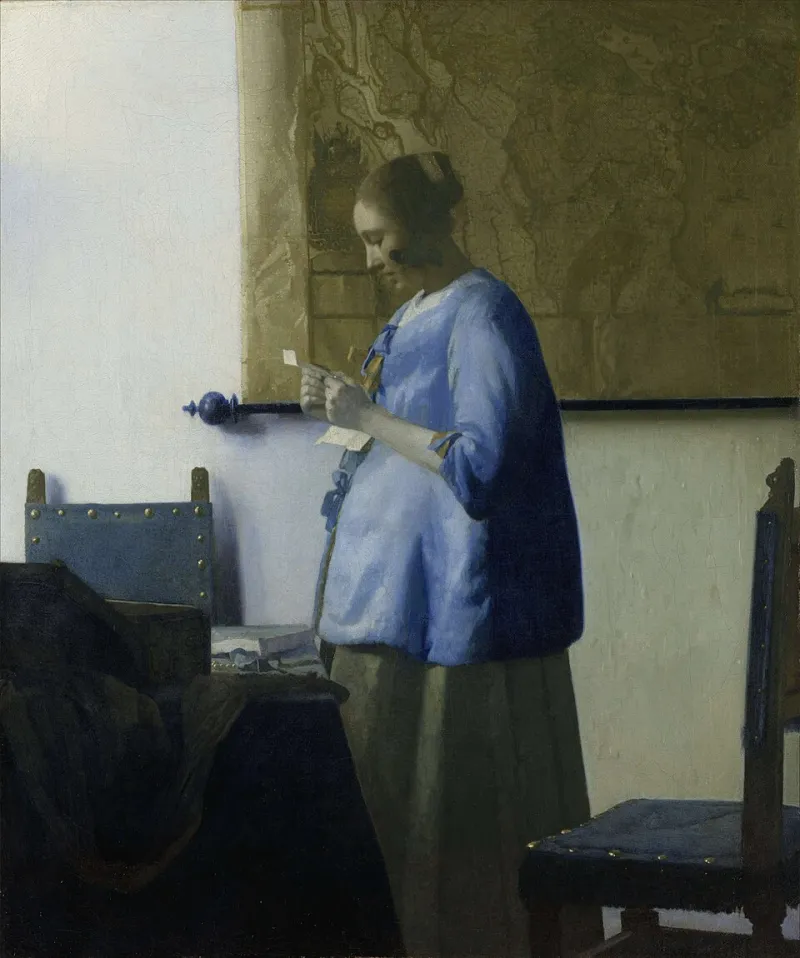
Photo: Johannes Vermeer, Public domain, via Wikimedia Commons
There's a particular kind of vertigo that hits when you find an old journal stuffed in the back of a closet. You sit down expecting a quick trip down memory lane, and instead you end up on the floor an hour later, genuinely shaken. Not because the memories are painful — though some are — but because you've just stumbled into an archaeological dig of yourself. Layer by layer, entry by entry, you're excavating a person you barely recognize.
That's the strange, underappreciated power of journaling as a time capsule. Not the version you intentionally create, where you write a letter to your future self with a knowing wink. The accidental one. The one you built without realizing it, in the margins of Tuesday evenings and 2 a.m. spirals.
The Archaeology of Your Own Anxiety
Here's what usually happens when you reread old entries: you find a problem you were absolutely consumed by. A relationship that felt like a riddle you'd never solve. A career crossroads that seemed to have no good exit. A version of yourself so tangled up in something that the journal pages practically vibrate with the urgency of it.
And then you realize — you don't remember how it resolved. Or you do, and the resolution feels almost embarrassingly simple from where you're standing now. The thing that occupied twelve pages of frantic, looping handwriting just... stopped mattering. Either you solved it, or you outgrew it, or life quietly moved the furniture around and suddenly there was nothing left to bump into.
That moment of recognition — oh, I got through that — is one of the most underrated feelings a journal can hand you. It's not triumphant, exactly. It's more like a quiet exhale. Proof, in your own handwriting, that you've survived more than you give yourself credit for.
The Bittersweet Part Nobody Warns You About
But here's the thing: rereading old journals isn't just a highlight reel of your growth. Sometimes you flip to an entry and feel a pang of something that's hard to name. Grief, maybe. Or tenderness. Because the person on those pages was trying so hard. They had a kind of raw, unfiltered hope that's harder to access now — not because you've become cynical, but because experience has a way of adding weight.
You might read about a dream you had that you've since let go of. A friendship that once felt foundational. A version of yourself who was, in some ways, braver than you are today — not because they had it figured out, but because they hadn't yet learned what could go wrong.
That's the bittersweet sting of genuine personal growth. It's not a straight line upward. It's a complex, sometimes contradictory map. And your old journal holds the whole thing, unedited.
What the Gap Actually Tells You
The distance between your past self and your present self isn't just a measure of time. It's a measure of everything that happened in between — the choices you made, the ones that were made for you, the things you absorbed without realizing it.
When you reread an entry from five years ago and think, I would never write that now, that's data. Maybe your values have shifted. Maybe your vocabulary for your own emotions has expanded. Maybe you've simply stopped apologizing for things that didn't need an apology.
The gap is the growth. Even when — especially when — it's uncomfortable to look at directly.
Some therapists actually use old journals as a tool in sessions, asking clients to bring in entries from years past and read them aloud. The exercise isn't about relitigating old wounds. It's about building what psychologists sometimes call narrative identity — the ongoing story you tell yourself about who you are and how you got here. When you can see that story in your own handwriting, spanning years, it becomes harder to dismiss your own resilience.
Making Peace With Who You Were
One of the most generous things you can do for your past self is to stop cringing at them. That person was doing their best with what they had. They didn't have the context you have now, the perspective, the hard-won clarity that only comes from living through the thing.
When you read an old entry and feel the urge to judge — why was I so dramatic about that? or I can't believe I stayed in that situation so long — try redirecting that impulse. Instead, get curious. What were they afraid of? What were they hoping for? What did they need that they didn't know how to ask for?
You might find that your past self was more perceptive than you gave them credit for. Sometimes old entries contain observations about people or situations that turned out to be exactly right — you just didn't trust yourself enough at the time to act on them.
The Invitation Hidden in the Archives
If you've got old journals sitting somewhere — in a box, on a shelf, tucked into a drawer — consider this your nudge to open one. Not to wallow, and not to perform nostalgia, but to actually look. To sit with whoever was writing back then and try to understand them the way you'd try to understand a good friend.
Bring a cup of coffee. Give yourself permission to feel whatever comes up — the pride, the grief, the secondhand embarrassment, the unexpected warmth. All of it is information about who you've been and, by extension, who you're still becoming.
Your journal has been keeping the receipts. It might be time to check them.