What Your Margins Are Confessing: The Secret Self-Portrait Hidden in Doodles, Stains, and Forgotten Sketches
There's a version of you that never edits itself.
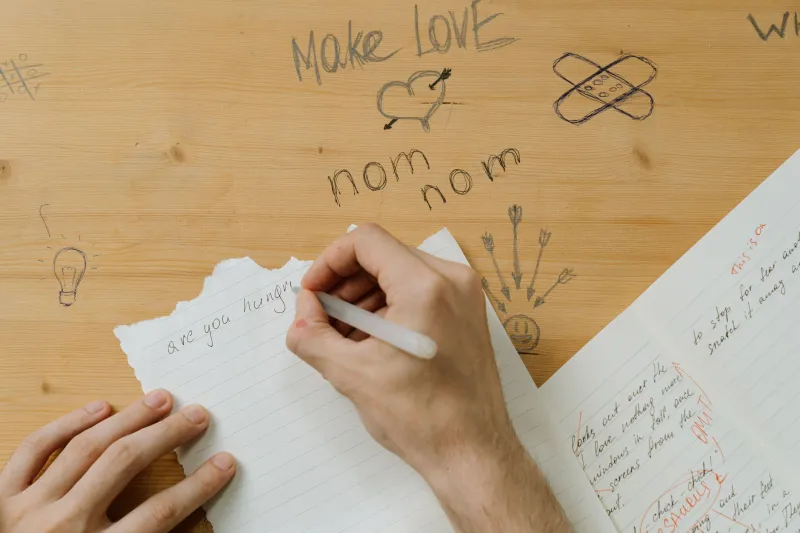
It doesn't pause to choose the right word or second-guess its feelings. It doesn't perform for a future reader or try to sound more put-together than it actually is. This version of you shows up in the margins — in the half-formed spirals you drew during a boring Tuesday Zoom call, in the coffee ring you never wiped off the corner of page forty-three, in the tiny bird you sketched next to someone's name without even realizing you were doing it.
Most of us treat these accidental marks as noise. Clutter. Evidence of distraction. But what if they're actually the clearest signal your inner world has ever sent?
The Page You Didn't Mean to Fill
When you sit down to write in your journal, there's a filter running. Even in your most private, most honest entries, some part of your brain is narrating — selecting, shaping, deciding what counts as worth saying. That's not a flaw. That's just how language works. Writing is inherently intentional.
But your margins? Those operate outside the filter.
The doodle you drew while you were on hold with your insurance company wasn't planned. Neither was the way you pressed a dried lavender sprig into the crease of a page during a particularly heavy week last October, or the way you circled one word seventeen times without noticing until you flipped back through. These marks carry information your conscious mind never authorized. That's what makes them so fascinating.
Think of it as the archaeology of your own attention. When a paleontologist digs through layers of sediment, they're not reading a story someone meant to tell — they're reading what time actually left behind. Your margins work the same way. They're the sediment of your real mental life.
What Different Marks Might Be Saying
Let's get specific, because this isn't just a poetic idea — it's a genuinely useful lens for self-reflection.
Geometric patterns and repetitive shapes — grids, concentric circles, rows of triangles — tend to show up when the mind is searching for order. If you flip through an old journal and notice that the margins get more structured during certain months, ask yourself what was happening then. Were you in the middle of something chaotic? Trying to hold a situation together? The geometry might have been your nervous system's way of coping.
Faces and figures, even rough and cartoonish ones, often appear when you're processing something interpersonal. The little face you drew next to a journal entry about a difficult conversation with your mom isn't random. Whether it looks angry or peaceful or blank tells you something about where your emotional energy was actually sitting, even if the words you wrote stayed measured and calm.
Food and drink stains are their own kind of time stamp. A journal page with a red wine ring and a smudge of chocolate tells a different story than one with a green smoothie drip and a highlighter streak. These marks are basically receipts — evidence of where you were, what you were consuming, what kind of mood you were creating around yourself that day.
Pressed objects — petals, ticket stubs, a folded receipt, a piece of tape from a package someone sent you — are perhaps the most emotionally loaded of all margin artifacts. You kept those things. You kept them specifically in that page, next to those words, at that moment. Even if you can't remember why, the impulse to preserve something physical alongside your written thoughts is a deeply human act of meaning-making.
The Honesty of the Unguarded Hand
Here's what's quietly remarkable about all of this: your hand knows things your prose doesn't always admit.
You can write "I'm fine with how things ended" in perfectly composed sentences. But if the margin of that page is covered in jagged, aggressive crosshatching, your hand might be telling a different story. You can write glowingly about an opportunity you're pursuing while your doodles in the corner are all closed shapes — circles with no exit, boxes within boxes. The body keeps the score, as they say, and the hand is part of the body.
This isn't pseudoscience or handwriting mysticism. It's just the observation that when we stop monitoring ourselves, we reveal ourselves. The margin is where that monitoring drops away.
How to Actually Do This Kind of Archaeology
If you've never thought about your margins as a source of self-knowledge, here's a low-pressure way to start exploring.
Grab an old journal — ideally one that's at least six months old, far enough back that you've got some emotional distance from it. Don't read the entries yet. Just flip through slowly and look only at the margins. Notice what's there. Notice what's not there. Notice when the margins get busy and when they go quiet.
Then ask yourself a few questions:
- Are there patterns in when certain types of marks appear?
- Do the margin drawings change in style or intensity across different time periods?
- Is there a page where the margin feels completely different from what the written words are saying?
- What did you save, press, or stick in, and why do you think that object ended up there?
You don't need to arrive at neat conclusions. The point isn't to decode yourself like a puzzle — it's to get curious about the parts of your inner life that don't usually get airtime.
Your Margins Are Already a Self-Portrait
Somewhere in your journals right now, there's a version of you that was never performing. It was just existing — half-present, hand moving, mind wandering somewhere honest and unguarded. That version left marks. Coffee rings and crooked stars and the outline of a hand you traced on a slow Sunday afternoon.
That's you too. Maybe more you than the carefully composed entries that surround those marks.
The written word is powerful. But the accidental mark? That's where the subconscious finally gets to speak without being edited. And if you're willing to slow down and look — really look — at the edges of your own pages, you might find a self-portrait you never knew you were making.
One that's been waiting quietly in the margins all along.